A Korean lettering tattoo uses Hangul — the Korean alphabet created in 1443 — as the design itself. Hangul letters are assembled into syllable blocks, so stroke weight and spacing decide how the piece ages, and a single wrong letter changes the meaning for good. Mini Ink Seoul (artist Haesol Choi) designs each lettering piece individually and verifies the Korean itself — spelling, nuance, and script style — before anything touches skin.
Updated September 2026.
Why Hangul works on skin
Hangul is one of the few writing systems designed from scratch: King Sejong introduced it in 1443 and promulgated it in 1446, and its 24 basic letters — 14 consonants and 10 vowels — are built from circles, straight lines, and squares (Hangul — Wikipedia). That geometry is why Hangul reads clearly at tattoo sizes where ornate scripts collapse. The letters don’t sit in a row like Latin; they stack into syllable blocks of two to four letters each, which gives even a single word a compact, balanced silhouette — and lets a phrase run vertically as naturally as horizontally. The document explaining the system, the Hunminjeongeum Haerye, is inscribed in UNESCO’s Memory of the World register (1997) (UNESCO).
The translation trap
Korean is a language of particles and registers: 사랑해 (saranghae, “I love you”), 사랑 (sarang, “love”), and 사랑하다 (saranghada, “to love”) are different words for different uses, and machine translation can easily pick the wrong one. On paper that’s a typo; on skin it’s permanent. Our rule is simple: you bring the meaning in English, and the artist — a native Korean speaker — translates it, checks spelling and nuance, and shows you the romanization and a literal back-translation before the stencil is made. If a phrase doesn’t work naturally in Korean, we say so and suggest what a Korean would actually write.
Choosing a script style
Korean lettering is not a font menu — it’s a choice between script traditions:
- Gungseo (궁서) — the court calligraphy style: brush-drawn, vertical-friendly, formal. The closest thing Korean has to “classic calligraphy.”
- Panbon-style (판본체) — modeled on early woodblock print: geometric, even-weight, quietly monumental. Suits minimal, modern pieces.
- Handwritten script — personal and soft; works for names, dates, and short phrases.
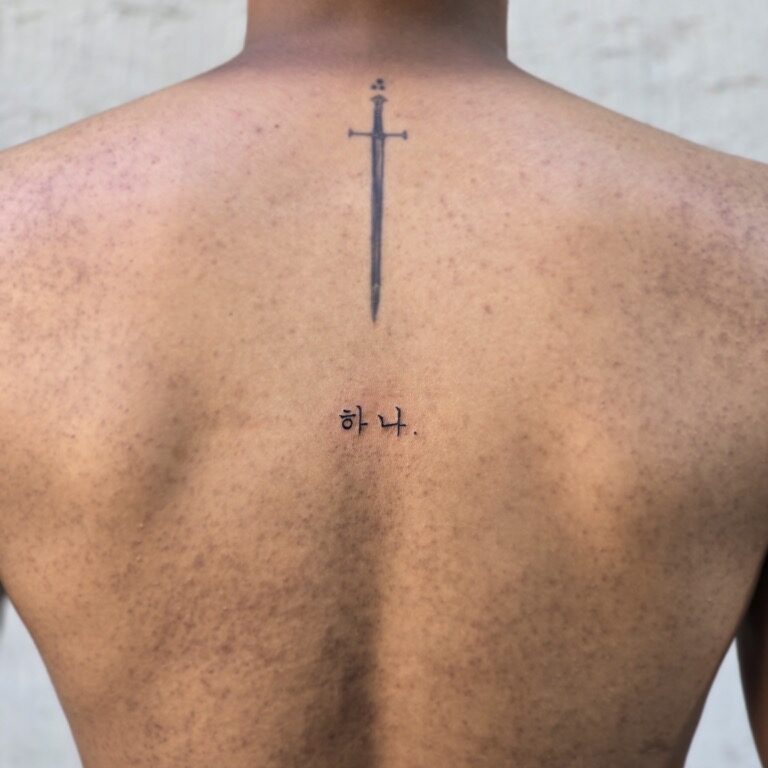
Vertical composition deserves special mention: because Hangul stacks in blocks, a word written top-to-bottom — the direction of traditional Korean texts — keeps its proportions in a way Latin letters can’t.
Size and placement
Most lettering pieces fall in the 1–5cm-per-character range. Ink spreads microscopically over the years, so small characters need stroke spacing planned for that spread from day one — dense, thin-lined blocks blur first. Placements that work well: the inner arm (low fade, moderate pain), the collarbone line (follows the body’s line), and the spine for vertical phrases. High-friction spots like fingers and wrists tend to fade faster and favor simpler, bolder blocks. Healing follows the usual arc — typically 2–4 weeks of moisturizing and sun avoidance; your artist’s aftercare instructions come first.
In the artist’s words
레터링은 문장의 의미만큼 글자의 간격과 획의 굵기, 몸 위에 놓였을 때의 흐름이 중요하다고 생각합니다. 문구와 부위에 맞게 형태와 균형을 조정해, 시간이 지나도 읽기 쉽고 자연스럽게 남도록 작업합니다.
“With lettering, I believe the spacing of the letters, the weight of the strokes, and how the line flows once it sits on the body matter as much as what the words mean. I adjust the shape and balance to the phrase and the placement, so the piece stays easy to read and looks natural as the years pass.”
Haesol Choi, September 2026 — translated from the Korean above
Recent Korean lettering work
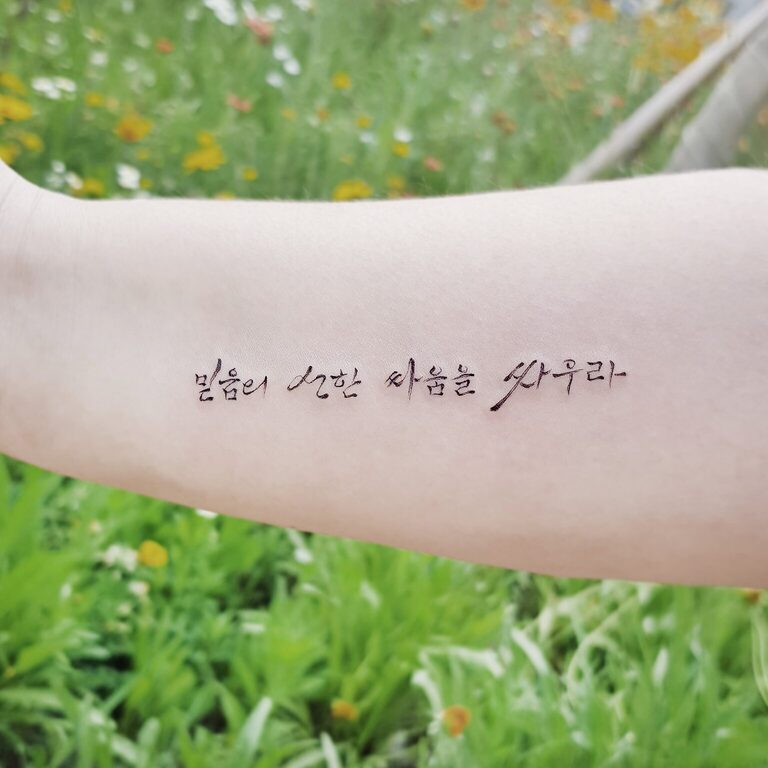
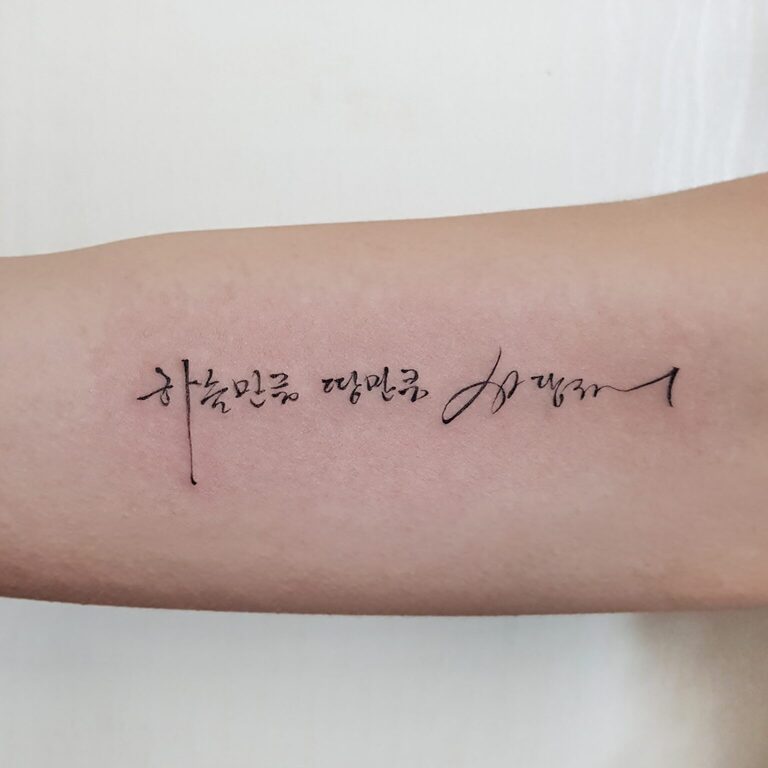
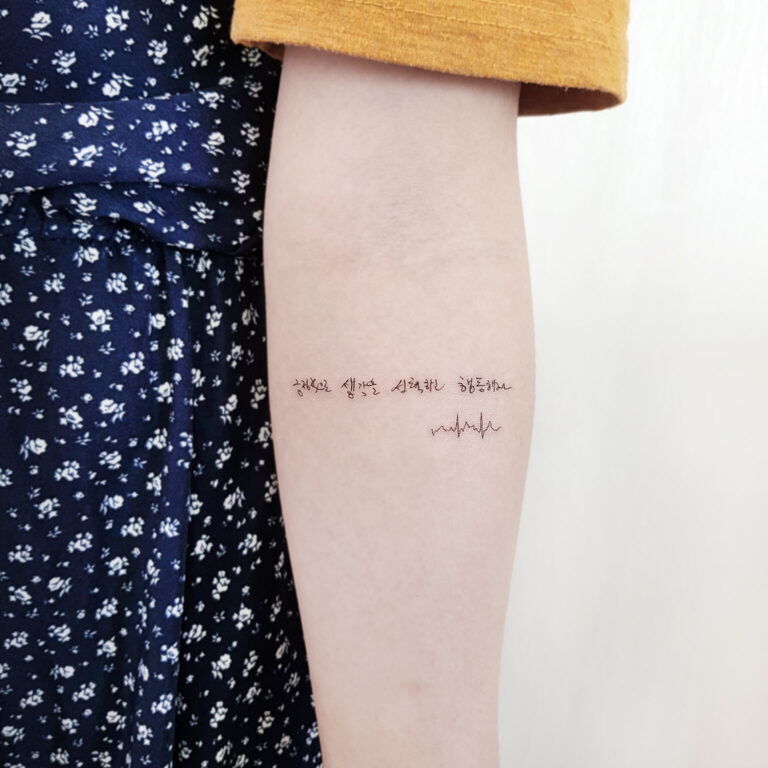
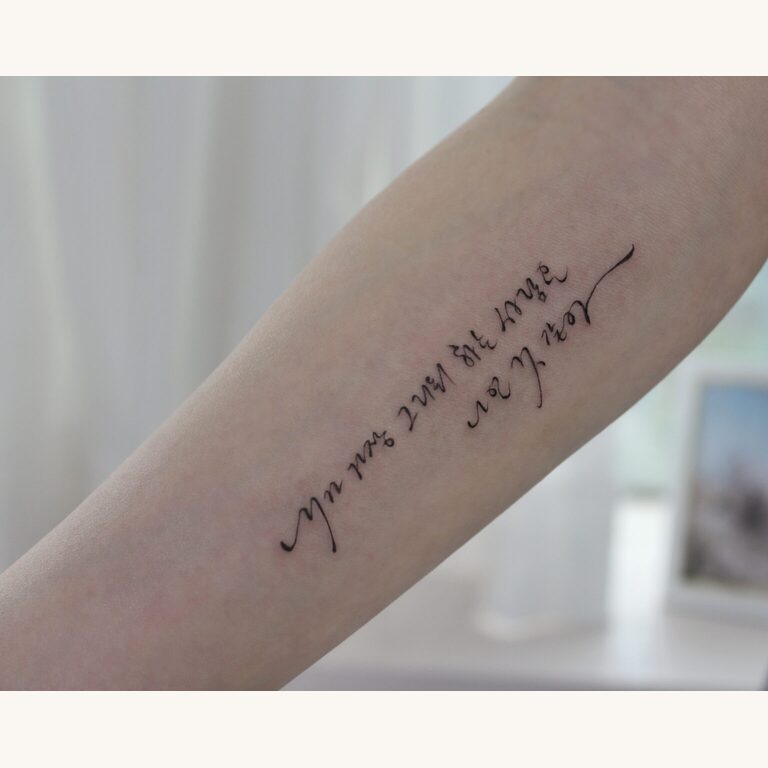
What does Korean lettering cost in Seoul?
Published Seoul market guides put small, simple pieces at roughly ₩150,000–300,000 (Korea Local Pages). Mini Ink Seoul doesn’t run a fixed price list — lettering is quoted individually after consultation, based on character count, script style, size, and placement. Consultations are available in English and answered within 24 hours.
Is it legal?
Yes. South Korea's Tattooist Act (Act No. 21070) was promulgated on 28 October 2025 and takes effect on 29 October 2027. Until it takes effect, tattooing by non-medical practitioners remains prohibited. This rule is about who may perform tattooing — it addresses the practitioner, not the person receiving a tattoo. Full context: Is Tattooing Legal in South Korea?
The artist
Haesol Choi began minhwa-style tattooing in 2016 and has worked with Korean and East Asian imagery for about ten years; he founded the traditional studio Onsil in 2021. Mini Ink Seoul is his casual line — small, minimalist, lettering, and everyday pieces. Every design is drawn individually; flash is never reused — see the gallery and client reviews. Visiting from abroad? See how to book a Korean tattoo from abroad.
FAQ
How do I know my Korean tattoo is spelled correctly?
Have it verified by a native speaker before the stencil — not after. At Mini Ink Seoul the artist translates your meaning himself, then shows you the romanization and a literal back-translation for confirmation. In our experience, machine translation alone is a common cause of misspelled Korean tattoos.
Should Korean lettering run vertically or horizontally?
Both work. Hangul stacks into syllable blocks, so vertical composition — the direction of traditional Korean texts — keeps its proportions naturally and suits the spine and limbs. Horizontal reads more modern. The right answer follows the placement’s own line.
How small can a Hangul tattoo go?
Characters around 1cm are possible, but ink spreads slightly over the years, so the denser the syllable block, the more space its strokes need. A good artist sizes the piece from the most complex character, not the simplest.
How much does a Korean lettering tattoo cost in Seoul?
Published Seoul guides put small, simple pieces at roughly ₩150,000–300,000. Mini Ink Seoul quotes individually after consultation — character count, script style, size, and placement set the price.